Quality Improvement and Programs
Quality maternal health care is dependent on having an adequate, comprehensive, and competent care team. Provider shortages, lack of comprehensive care (doulas, social workers, mental health professionals, at-home care), and lack of communication and best practices across the care team all contribute to poor maternity care outcomes. Our team has worked closely with our partners in Missouri, including one of the largest health systems in the state, to survey maternal health personnel, define pain points experienced across care teams, and develop models of care to improve maternal health outcomes across the state.
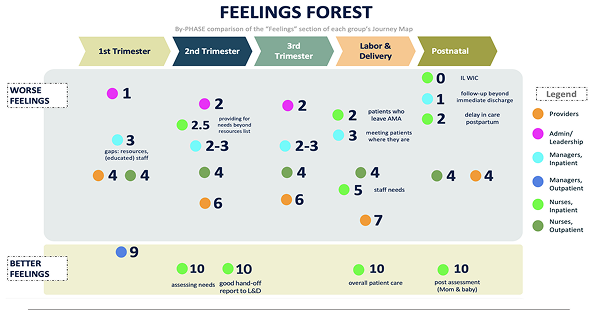
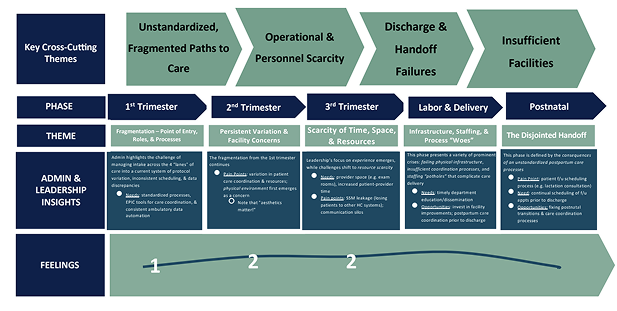
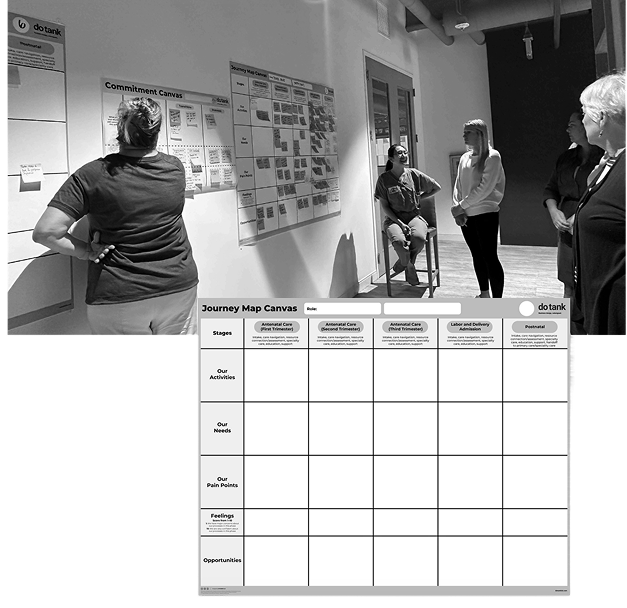
In partnership with SSM Health, our team launched a Journey Mapping project in 2025 to better understand the existing state of pregnancy care across one of Missouri’s largest health systems. The project’s ultimate goals were standardizing the provision and comprehensiveness of quality pregnancy care, collecting more informative and actionable health outcomes data, and designing a framework for more seamless care team communication.The first session of this Journey Mapping project was focused specifically on providers and other healthcare personnel.
For the providers and maternal care workforce session, our team facilitated a high-impact in-person workshop centered on the current state of pregnancy care across both inpatient and outpatient clinical care. Providers, administrators, and other healthcare personnel collaborated across six distinct clinical groups to break down every aspect of pregnancy care they provide and/or oversee, ranging from the first trimester through labor and delivery to the postpartum and transitionary periods. Experiences were shared across and within both roles and care structures alike, centered around topics such as trimester-based care responsibilities, role-specific pain points, and system-wide gaps and barriers to adequate care provision. The session concluded with personnel-wide collaboration on what an “ideal system” for pregnancy care looks like and what steps to take, both concrete and abstract, to most closely align the current state of SSM pregnancy care with their ideal future state.
Our team is now in the process of preparing a complementary, patient-facing pregnancy journey mapping series with participating SSM reproductive health patients. Through a set of facilitated interviews and focus groups centered around participants’ experiences with navigating SSM pregnancy care, this iteration of Pregnancy Journey Mapping aims to capture patient perspective on what care recipients think about the state of the care they receive.
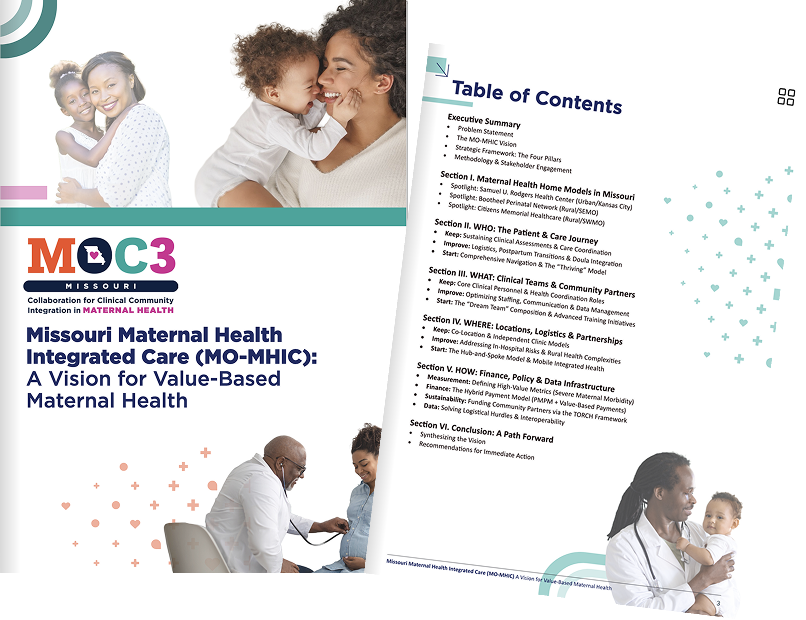
In 2025, alongside partners in Missouri, our team developed the Missouri Maternal Health Integrated Care (MO-MHIC) report, which establishes a strategic blueprint to transform the state’s fragmented, volume-based maternal healthcare system into a proactive, value-based integrated model. Developed through four months of field research and stakeholder collaboration, this report identifies critical gaps in postpartum care and clinical-community communication, proposing a “Hub-and-Spoke” framework that braids clinical safety with social and behavioral supports. This report develops a four-pillar model—focusing on the patient journey, multidisciplinary teams (including RN coordinators and Community Health Workers), optimized care locations, and a hybrid financial structure. The findings from this report advocate for a shift toward a 12-month postpartum care standard and the implementation of value-based payments tied to high-impact metrics like reduced maternal morbidity, ensuring a sustainable and equitable healthcare ecosystem for all Missouri mothers.
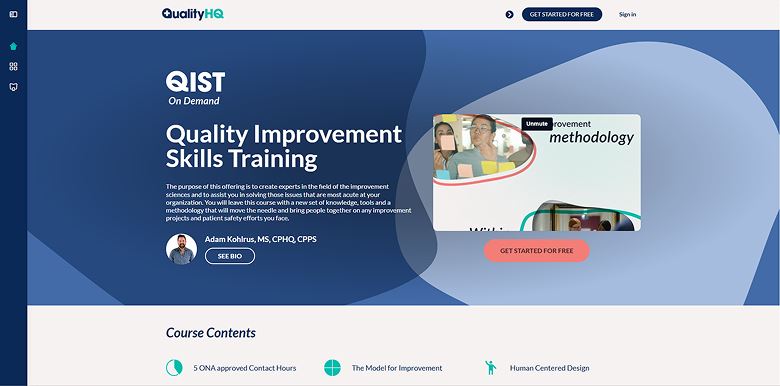
The Quality Improvement Skills Training (QIST) offering, available through QualityHQ, provides a specialized curriculum designed to transform healthcare professionals into experts in improvement sciences by merging the Model for Improvement (MFI) with Human-Centered Design (HCD). This hybrid approach leverages Do Tank’s expertise in HCD to supercharge traditional quality improvement efforts, utilizing visual canvases and design thinking tools to manage complexity, align stakeholders, and foster deep collaborative conversations among frontline staff. Available in on-demand, in-person, or consulting-supported formats, the course guides learners through the construction of aim statements, data management via run charts, and the execution of PDSA cycles. By the conclusion of the training, participants gain practical knowledge and a completed project charter, equipping them with a repeatable, empathy-driven methodology to solve acute organizational issues and drive meaningful, systematic change in patient safety and clinical outcomes.
To learn more about our work with maternal health leaders across the country, or to ideate around how to best leverage your state’s RHTP and other funding to improve maternity care outcomes, contact us below. We would love to chat!
Lorem ipsum dolor sit amet, consectetur adipiscing elit. Ut elit tellus, luctus nec ullamcorper mattis, pulvinar dapibus leo. Lorem ipsum dolor sit amet, consectetur adipiscing elit. Ut elit tellus, luctus nec ullamcorper mattis, pulvinar dapibus leo.
Lorem ipsum dolor sit amet, consectetur adipiscing elit. Ut elit tellus, luctus nec ullamcorper mattis, pulvinar dapibus leo.
This is the objective section. Here, we clearly state why we were hired, what the goals are, what the metrics for success are, and what the macro impact of the project is. Questions to remember: Why is this work important to this company? What do they have to gain? Lose? What have they lost already by not tackling this issue?
GET SPECIFIC. Do not attempt to vaguely market toward other businesses.