Our team has developed dozens of playbooks for our partnering organizations, guiding them in addressing their gaps and driving systemic change. Playbooks are an effective tool for organizations that know their pain points but not how to best address them – they are particularly fit for organizations looking to integrate best practices that reduce harm and improve care in a very practical way. Playbooks are focused on specific topics and most often used by providers and those on the front lines of healthcare. Over the past few years, our team has created playbooks on sepsis, social drivers of care, reducing readmissions, and more.
The NCHF Social Impact Playbook
In 2024, we partnered with the North Carolina Healthcare Foundation (NCHF) to develop their Social Impact Playbook, which serves as a strategic guide for healthcare systems, community organizations, and residents to collaboratively address non-medical drivers of health such as housing, transportation, and education.
The Purpose
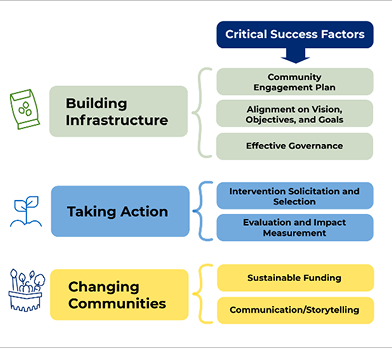
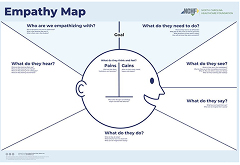
The Social Impact Playbook serves as a strategic roadmap for Community Development Teams to transition from reactive “sick care” to proactive health interventions that address the root causes of systemic inequities. By functioning as the connective tissue between community needs and systemic action, these teams align health systems, grassroots organizations, and residents with lived experience to co-design sustainable solutions. To bridge the gap between abstract social challenges and concrete results, the playbook utilizes human-centered design tools like the Empathy Map Canvas, which grounds planning in the actual daily realities of community members rather than external assumptions. Additionally, the Systems-Thinking Logic Model helps teams look beneath visible symptoms to analyze the deeper patterns and mental models that maintain the status quo over time. To ensure these initiatives are financially viable, the guide provides a dedicated ROI Calculator to project cost savings from reduced emergency department visits and shorter hospital stays. Beyond hard numbers, the framework also tracks intangible but vital benefits such as strengthened community trust and improved staff retention, which traditional fiscal tools often overlook. These outcomes are eventually funneled into a Value Proposition Canvas to create an evidence-based call to action for prospective funders and policymakers, aiming for long-term scalability and lasting community change.
Some of the Human-Centered Design tools and canvas featured in this playbook include:
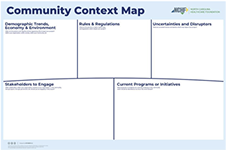
Community Context Map
Maps the broader ecosystem of a challenge, including demographic trends, regulations, and localized uncertainties.
Empathy Map Canvas
Used to deeply understand the lived experiences, motivations, and pain points of community members.
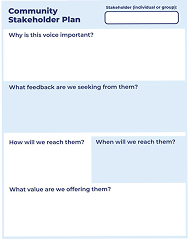
Community Stakeholder Plan Canvas
Helps identify and vet potential community influencers and partners to join the development team.
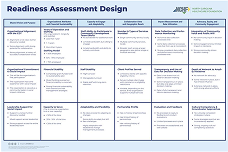
Readiness Assessment Design Canvas
Customizes a tool to evaluate if potential partners have the leadership and resource capacity to collaborate.
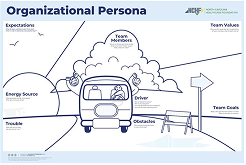
Organizational Persona Canvas
Captures the specific values, expectations, and “drivers” of individual organizations within the team.
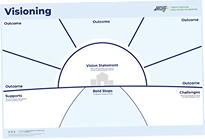
Visioning Canvas
Establishes a shared “North Star” and identifies the bold steps needed to achieve long-term social impact.
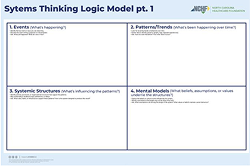
Systems-Thinking Logic Model Canvas
Uses the “Iceberg Model” to uncover the deep-rooted systemic structures and mental models behind social issues.
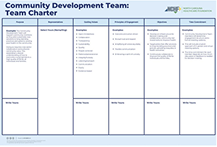
Community Development Team Charter Canvas
Outlines the team’s mission, behavioral norms, and specific roles to ensure accountability.
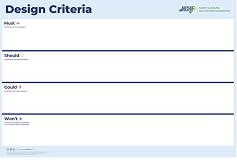
Design Criteria Canvas
Establishes project guardrails by defining what must, should, could, and won’t be included in an initiative.
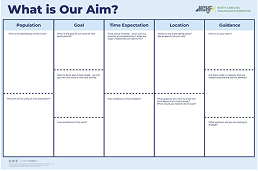
Aims Canvas
Crafts an explicit aim statement by defining the specific population, goal, timeline, location, and guidance.
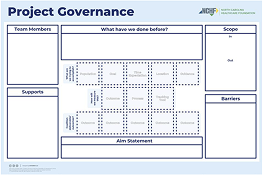
Project Governance Canvas
Acts as an operational roadmap to flesh out project outcomes, deliverables, and success measures.
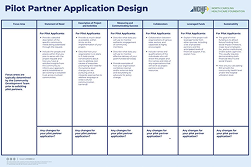
Pilot Partner Application Design Canvas
Standardizes the application process for potential pilot projects based on community priorities.
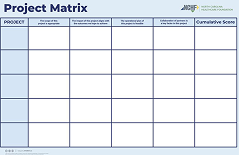
Project Matrix Canvas
Provides a framework to vet and prioritize pilot initiatives based on their feasibility and impact.
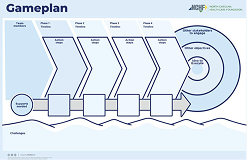
Gameplan Canvas
Builds a phased implementation plan that identifies specific action steps and necessary supports.
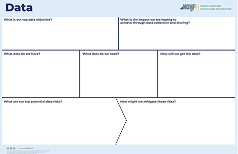
Data Canvas
Creates a consensus on what data is needed to demonstrate success and identifies potential data risks.
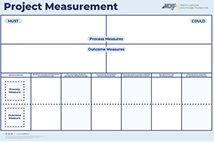
Project Measurement Canvas
Allows pilot sites to define their specific process and outcome measures for evaluation.
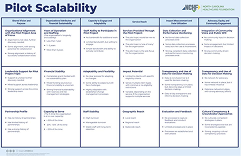
Pilot Scalability Canvas
Identifies candidates to adopt a solution long-term based on their financial and organizational attributes.
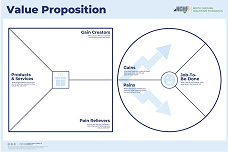
Value Proposition Canvas
Translates project results into quantifiable benefits (gains) and problem-solving (pain relief) for stakeholders.
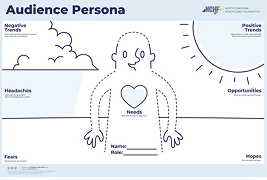
Audience Persona Canvas
Profiles the specific needs and fears of decision-makers to help tailor impact stories.
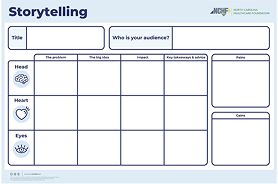
Storytelling Canvas
Structures a narrative using a “head, heart, and eyes” approach to pitch collective impact to future funders.
North Carolina Healthcare Foundation Social Impact Playbook
To learn more about our work with maternal health leaders across the country, or to ideate around how to best leverage your state’s RHTP and other funding to improve maternity care outcomes, contact us below. We would love to chat!
Lorem ipsum dolor sit amet, consectetur adipiscing elit. Ut elit tellus, luctus nec ullamcorper mattis, pulvinar dapibus leo. Lorem ipsum dolor sit amet, consectetur adipiscing elit. Ut elit tellus, luctus nec ullamcorper mattis, pulvinar dapibus leo.
Lorem ipsum dolor sit amet, consectetur adipiscing elit. Ut elit tellus, luctus nec ullamcorper mattis, pulvinar dapibus leo.
The Objective
This is the objective section. Here, we clearly state why we were hired, what the goals are, what the metrics for success are, and what the macro impact of the project is. Questions to remember: Why is this work important to this company? What do they have to gain? Lose? What have they lost already by not tackling this issue? GET SPECIFIC. Do not attempt to vaguely market toward other businesses.