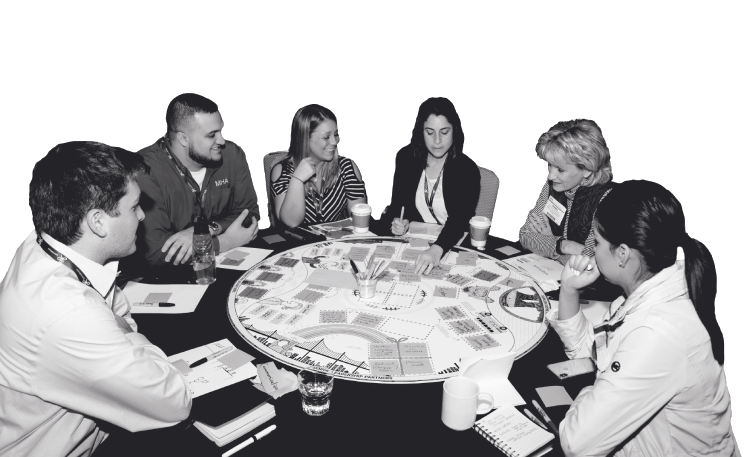
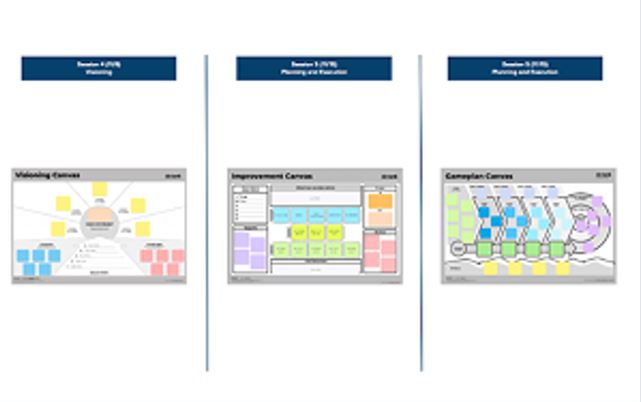
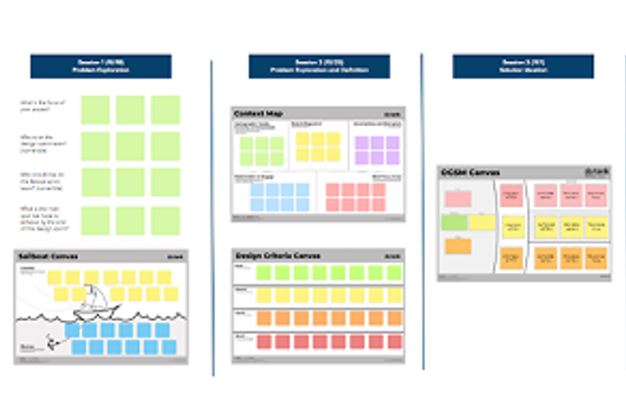
Our team employs learning collaboratives – or long-term virtual programming cohorts – to drive hospitals, health systems, and other community groups to action. During these collaboratives, we guide participants through our published three-phase human-centered framework: Opportunity Exploration, Concept Development, and Value Creation. Participants navigate these phases via optimized human-centered design tools such as empathy maps, matrix diagrams, gameplanning canvases, charter builds, and more. While possible to complete individually, these collaboratives are designed for teams and encourage collaboration at the organization level.
District of Columbia Hospital Association: IHI Breakthrough Series on the Perinatal Mental Health Change Package
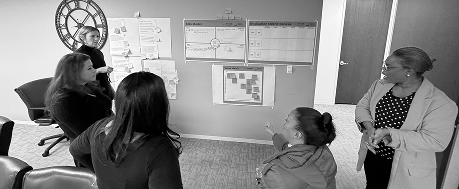
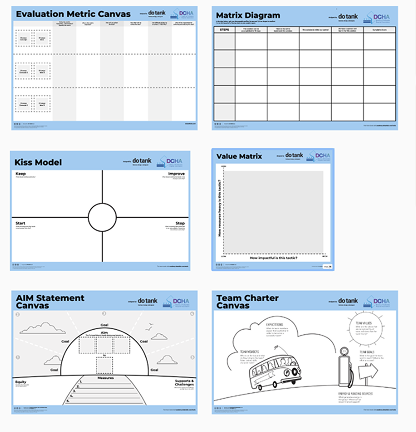
In 2025, our team partnered with the Hospital Association of the District of Columbia to facilitate a session with their collaborative members around the IHI perinatal mental health change package. We flew to DC and implemented human centered design methodologies to guide local subject matter experts through a process of narrowing down the change concepts to a handful of essential focus areas. Specifically, our team integrated tools such as a Team Charter Canvas, KISS Model, Value Matrix, Matrix Diagram, Evaluation Metric Canvas, and AIM Statement Canvas into DCHA’s learning collaborative. The Team Charter Canvas and KISS Model served as introductory level-setting activities that aligned collaborative members. The Value Matrix and Matrix Diagram then guided a fleshed out conversation around the change topics and what areas of the focus had the most value. Finally, the Evaluation Matrix Canvas and AIM Statement Canvas guided the conversation to place of action and next steps. Contact us to hear more about integrating human centered design methodology into learning collaboratives, or to hear about designing learning collaboratives from the ground up in the health care space.
Midwest AIDS Training and Education Center: HIV Prevention & Care
In 2025, alongside partners in Missouri, our team developed the Missouri Maternal Health Integrated Care (MO-MHIC) report, which establishes a strategic blueprint to transform the state’s fragmented, volume-based maternal healthcare system into a proactive, value-based integrated model. Developed through four months of field research and stakeholder collaboration, this report identifies critical gaps in postpartum care and clinical-community communication, proposing a “Hub-and-Spoke” framework that braids clinical safety with social and behavioral supports. This report develops a four-pillar model—focusing on the patient journey, multidisciplinary teams (including RN coordinators and Community Health Workers), optimized care locations, and a hybrid financial structure. The findings from this report advocate for a shift toward a 12-month postpartum care standard and the implementation of value-based payments tied to high-impact metrics like reduced maternal morbidity, ensuring a sustainable and equitable healthcare ecosystem for all Missouri mothers.
Contact Us
To learn more about our work with maternal health leaders across the country, or to ideate around how to best leverage your state’s RHTP and other funding to improve maternity care outcomes, contact us below. We would love to chat!
Lorem ipsum dolor sit amet, consectetur adipiscing elit. Ut elit tellus, luctus nec ullamcorper mattis, pulvinar dapibus leo. Lorem ipsum dolor sit amet, consectetur adipiscing elit. Ut elit tellus, luctus nec ullamcorper mattis, pulvinar dapibus leo.
Lorem ipsum dolor sit amet, consectetur adipiscing elit. Ut elit tellus, luctus nec ullamcorper mattis, pulvinar dapibus leo.
The Objective
This is the objective section. Here, we clearly state why we were hired, what the goals are, what the metrics for success are, and what the macro impact of the project is. Questions to remember: Why is this work important to this company? What do they have to gain? Lose? What have they lost already by not tackling this issue? GET SPECIFIC. Do not attempt to vaguely market toward other businesses.