The Hospital Association of Pennsylvania Learning Action Network
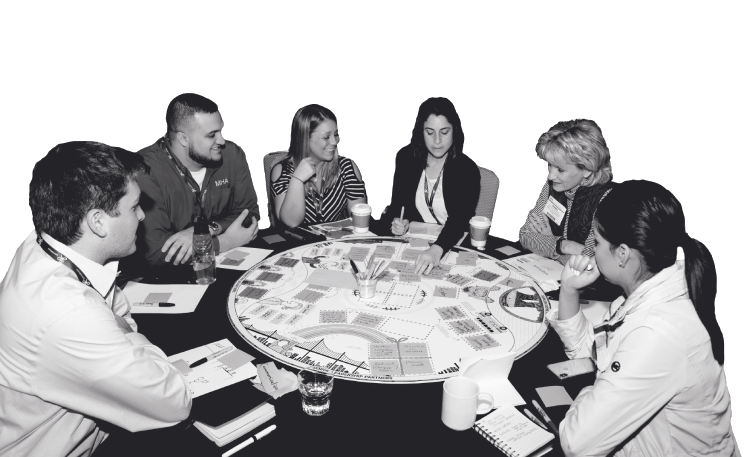
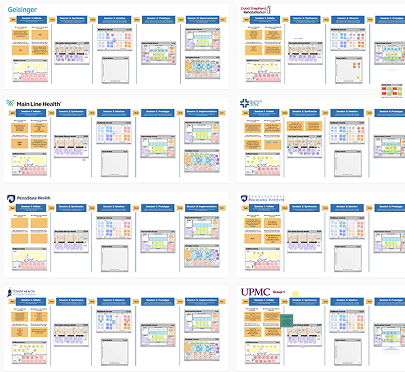
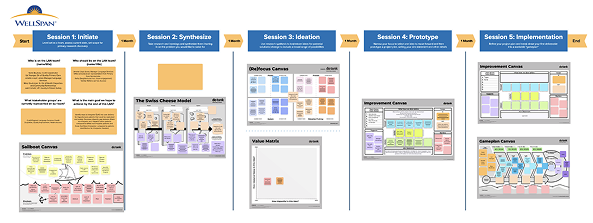
We worked alongside our partners at the Hospital Association of Pennsylvania to design and facilitate two cohorts of their Learning Action Network (LAN): the Culturally Appropriate Patient Care cohort and the Collection and Use of Data to Drive Action cohort. Both cohorts were centered on a commitment to eradicating racial health inequities for Pennsylvania health care consumers. Upon enrollment in the cohort, each organization decided on a project, problem, or focus area within Culturally Appropriate Patient Care and/or Collection and Use of Data to Drive Action to focus on over the course of the cohort. We guided each cohort through a 5-session virtual learning collaborative, employing human centered design methodology to help them ideate solutions around their topic of focus. Once again, we also integrated peer-to-peer learning into the collaborative, having different teams pair off at the end of each session to coach each other through their work.
Comagine Health
A Bi-state Cross-Collaboration between Hospitals and Nursing Homes to Improve Sepsis Outcomes
Our team partnered with Quality Improvement Organization Comagine Health to design and facilitate several different workstreams related to their focus areas of opioids, sepsis, and vaccinations.
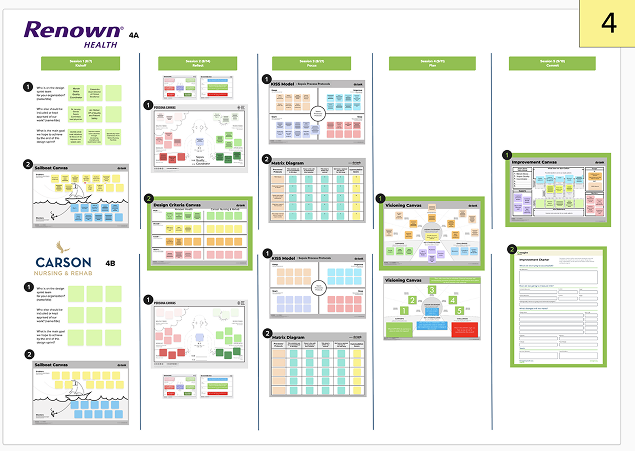
For the sepsis workstream in particular, we developed a bi-state initiative (Sepsis Design Sprint) focused on coordination between hospitals and nursing homes with the aim of enhancing Sepsis outcomes. We built out messaging, outcomes, content, and recruitment strategies for the Sepsis Design Sprint in summer 2024 and deployed the sprint the following fall. The sprint was eight weeks and six sessions long, integrating human centered design methodology throughout its duration. As many as 20 organizations (10 hospitals/10 nursing homes) participated in the sprint and validated the approach. The pairing of hospitals with nursing homes allowed for cross-collaboration among facilities that are often siloed in their approach.The hospitals and nursing homes collaborate together in a neutral, peer-to-peer environment to strategically address the Sepsis Recovery Transition Zone allowing for more rigorous solution ideation and increased accountability for implementing said solutions. By identifying facilities with shared patient populations, this collaborative experience moved beyond the “bias of the past” and a culture of blame to instead focus on the high-risk 72-hour window surrounding a patient’s discharge. Engaged teams were upskilled in human-centered design techniques—such as empathy mapping and rapid prototyping—to co-create a unified “Sepsis Care Bundle” to improve clinical stability and reduce readmissions. This collaborative peer-to-peer work aimed to transform fragmented hand-offs into a seamless, collaborative continuum of care.
Contact Us
To learn more about our work with maternal health leaders across the country, or to ideate around how to best leverage your state’s RHTP and other funding to improve maternity care outcomes, contact us below. We would love to chat!
Lorem ipsum dolor sit amet, consectetur adipiscing elit. Ut elit tellus, luctus nec ullamcorper mattis, pulvinar dapibus leo. Lorem ipsum dolor sit amet, consectetur adipiscing elit. Ut elit tellus, luctus nec ullamcorper mattis, pulvinar dapibus leo.
Lorem ipsum dolor sit amet, consectetur adipiscing elit. Ut elit tellus, luctus nec ullamcorper mattis, pulvinar dapibus leo.
The Objective
This is the objective section. Here, we clearly state why we were hired, what the goals are, what the metrics for success are, and what the macro impact of the project is. Questions to remember: Why is this work important to this company? What do they have to gain? Lose? What have they lost already by not tackling this issue? GET SPECIFIC. Do not attempt to vaguely market toward other businesses.